Sunday, September 27, 2015

TOW #3 - War Child Advertisement


Violence has been spreading to kids all over America, and in other countries as well. They are beginning to think war is a game. This idea is depicted in the image because the grenade, usually know for explosions and destruction, is simply just a balloon that can do no harm to anyone. It continues to go on and say help stop the use of child soldiers, which is a major occurrence all over the world. The idea of war is a game is implanted in the children's minds through video games, and from being exposed to war zones far too often. All this is doing is promoting violence, and that war is nothing harmful. If we die, it's fine because we are back in the game five seconds later. However you don't get unlimited lives in Afghanistan when al Qaeda are firing rockets at you from the depths of the wooded mountain tops. What better way to promote this message, then by having the charity company War Child create a anti-war poster for children? The goal of the organization is to help empower young children in areas of war by giving them psycho-social support, and by promoting education, giving clear credibility on this subject.

The audience of the message then is clear. Not only is it directed towards the kids who are struggling in the areas of war, but its mostly to the people of third world countries, like the U.S. We have to embed in our children's minds that war is nothing even close to a game. It also promotes third world countries into donating towards the charity, to help the kids without proper structure, and who are at risk of becoming child soldiers. This message is delivered through the use of metaphors, pathos, and irony. The metaphor is clear, that war is a game. The purpose of the image is to then shut down that metaphor, and to convince people to help fight against the idea being that war is a game. The pathos is created by us being so urged to support the cause, just thinking of the child soldiers without education, parents, or a normal life. Lastly, the irony being that the balloon as a grenade, at first glance, seems to support the idea that war is a game, but then the texts contrasts that thought. Trough the use of these rhetorical devices, the War Child charity created a successful and effectively ad to draw people into donating to help the cause of child soldiers around the world.

Sunday, September 20, 2015

TOW #2 - Rethink U.S. arms sales to Bahrain

Recent legislation has been passed by the US State Department that allows for the resume of arm sales to Bahrain. Conflict arises with this decision because many people believe that the US should not aid a country that purposefully represses peaceful protesters. In Bahrain, the ruling regime has been cracking down on anyone who stands in the way of their power, such as human rights activists, and opposing leaders. The reason the State Department went through with this legislation is because the leaders have said that they have fully implemented the recommendations of the Bahrain Independent Commission of Inquiry, but in reality, have only established 5 out of the 26. In the last paragraph, the author, Ron Wyden, states that he strongly disagrees, and that, “The United States should only restart these arms sales in response to real reform, not continued repression,” (Wyden para. 12).  Wyden is definitely considered a credible source based on the fact that he has significant experience in the field of foreign policy, and that he has been in the House of Representatives for 15 years. He has been in the senate for almost 20 years. The audience of his op-ed is most likely adults aged 21-35. These are the people that are most involved in the news, and the one with very strong political views. Wyden’s purpose is clear; to argue that the passing of the bill to resume arm exchange with Bahrain only shows that we are supporting repression, and not reform. He delivers this message with rhetorical devices such as allusions. In the middle of the editorial, he alludes to the prior events that have happened in the Middle East, where peaceful protests lead to violence and chaos, started by the regime trying to repress their activists. For this reason, I believe Wyden to be successful in conveying his message of the fact that we must not support those trying to repress freedom. 


Tuesday, September 15, 2015

TOW #1 - Pope Francis and Donald Trump: Two Kinds of Power

Over the years, we have seen many leaders who have had different approaches to how they run their organization, or their country. There have been leaders of democracies, theocracies, and monarchies, all with different characteristics that separate them from one another. In this article, the leadership qualities of Pope Francis and Donald Trump are under the examination of Brian Frawley. Frawley is a former Catholic priest, and is now a principal of Hay Group in Boston. His practice focuses on leadership development and executive assessment, which combined makes him a pretty reliable source when it comes to an opinionated piece. The two types of leadership he discusses are "personal power" and "social power". Personal power "gathers energy and excitement from winning, from standing over and above others as conqueror and victor," (Frawley para. 3). He later goes on to explain how this type of power shows a strong desire for control. On the other hand, social power is aimed towards elevating others, expressing their full potential. The audience of this op-ed is most likely adults aged 21-35, because they are the most involved in these kinds of politics. Also, they are the ones responsible for whether or not Trump will be elected president. With that being said, clearly the rhetoric being used by the author was juxtaposition. He is essentially comparing the difference between two types of power, and then goes on to explain how they are successful, and likewise, unsuccessful. If we pay close attention, we can see that the author favors social power over personal power, and by using juxtaposition, he gets his purpose across to the reader in a well organized fashion. In my opinion, the purpose of the text is simple: to exploit one type of power (personal), and to support the benefits of another (social). When Frawley discusses the idea of social power, he uses a much more inspiring tone, compared to the basic monotone of personal power. He states, "It draws on inspiring language and symbolic actions to help people find their own power, both individually and collectively..." (Frawley para. 7).  So when it comes to whether or not the author wrote a successful op-ed, I side with yes due to the strong examples he uses, along with the rhetorical devices.


Monday, September 14, 2015

IRB Intro Post

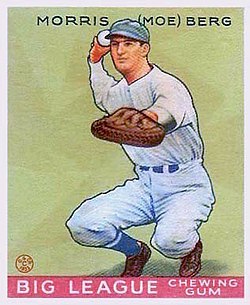
The title of the book that I have chosen is The Catcher Was a Spy, written by Nicholas Dawidoff. The book singles out a catcher in Major League Baseball, whose name is Moe Berg. It is essentially a biography about how Berg spent 16 years in the MLB, and played for five different teams. However at age 39, Berg put to use his foreign language skills, and enrolled in the military as the United States entered World War II. The book later goes into in depth details about some of Moe's missions as a US spy, specifically about his investigations on Germany's work on nuclear energy and atomic weapons. The author provides the reader with a careful and sympathetic story about the struggles and successes of the only Major League Player to have his baseball card on display at the CIA headquarters in New York. I chose to read this book because it combines two things that I thoroughly enjoy: baseball and war efforts. My goal from reading this biography is to learn more about what the life was like first hand in WWII, and also to learn about the story of a man who had it all, and chose to help defend his country, instead of watching from the comfort of his home.