Sunday, October 25, 2015
TOW #7 - The Empire Strikes Back
In an 11-hour hearing, Hillary Clinton once again assumed the role of the victim against her swarming Republican opponents. The topic of course; her personal email sever set up that consisted of "classified" information on Benghazi along with other intelligence. The author of the opinion piece, Maureen Dowd, believed that Hillary once again preformed when all eyes were on her. She also believed that the Republicans, such as Trey Gowdy, "came fishing without their fishing poles" or in other words, came to the hearing without any new information revealing more about Hillary and her personal server. Dowd, winner of the 1999 Putzler Prize for distinguished commentary has been an op-ed columnist since 1995 on topics such as American politics and international affairs. Such an accomplished writer clearly has credibility in a topic such as this. There were two specific rhetorical devices that she used in her piece. One of those was the repetition of the phrase "If her..." and the idea of her sympathy. Within the first three paragraphs, we see how Dowd views Clinton as masterful when playing the role of the victim. She states, "If her husband humiliates her... Hillary turns around and uses her sympathy." (para. 3). In the next sentence, Dowd states, "If her Republican opponent gets her in space... she turns around and uses the sympathy." The reason for why this is so effective, is because one, it reveals how she is so masterful in the examples of when she is the victim, and two, it creates sympathy for Clinton, because we feel bad as the audience, seeing that she is often the victim. She also used inferior diction to describe the Republicans approach to the hearing. She states, "She was not amazed at what an amateur job they were doing..." (para. 8). This gives way to the fact that Hillary once again established herself as victorious in the role as the victim. By using words like amateur, the audience gets the sense that the Republicans weren't prepared for the battle with Clinton, and it cost them. In her piece "The Empire Strikes Back", Dowd effectively uses inferior diction as well as persuasive repetition in order to achieve her purpose, which is that Hillary Clinton was masterful and effective in her hearing on October 24th.

Sunday, October 18, 2015
TOW #6 - Yes, Wall Street Needs Help
In the
article “Yes, Wall Street Needs Help”, the author brings about some issues on
Wall Street, and how they can eventually be a major detriment to the economy
and to the financial security of people all over the United States. One of the
first issues that Kathryn Wylde touches upon is that over the past five years,
over 25,000 financial services jobs have been laid off, and then shares her
ideas on how this will affect the city and beyond. When she discusses this
topic, the major rhetorical device that is used, happens to be logos. She
states, “Most of the estimated 310,000 financial-services workers in New York
City — down from 360,000 in 2000 — are in the middle class. Fifty-one percent
make less than $100,000 a year” (para. 4). This is significant because of the
fact that it clearly shows how the number of workers has decreased, and how
these people are now in a tough situation financially without a job.
She moves on to talking about how some people don’t care about the
economic aspects of the city. Here she brings out the rhetorical device or
juxtaposition, or more of a “They say, I say” approach. “Critics who think the
financial-services sector is still too big, and that salaries at the top are
still too high, might say: So what? But that is not a view anyone who cares
about our city can afford to take” (para. 3). By using the idea of comparing
what some people believes in, and then talking about her beliefs, she refers to
her purpose. Her purpose being that people need to pay more attention to Wall
Street due to how much impact it has on our lives.
Kathryn Wylde is the Chief Executive Officer and President of The
Partnership for New York City, Inc. as well as the Chamber of Commerce, Inc.,
so clearly she has a lot of knowledge in the world of commerce, establishing her
ethos.
Through the use of ethos, logos, and juxtaposition, Wylde effectively demonstrates
her purpose in that Wall Street needs to be functioning fluently in order for
society to function as well, in her article “Yes, Wall Street Needs Help”.
Sunday, October 11, 2015
TOW #5 - Israeli Palestinian Conflict
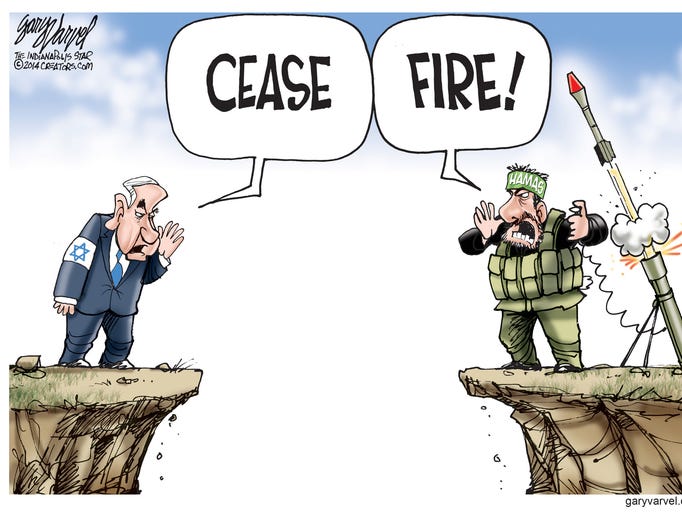
In the political cartoon above, the Israeli – Palestinian conflict is
clearly the topic of discussion. The obvious is that there is a political figure
of Israel, and a leader of the Hamas terrorist group. The man from Israel is
calling for a cease, yet the Hamas figure shouts fire. Interestingly, when you
put the two quotes together, you get “cease fire” which is what the main goal
is, however separate, there is a sense of bias established by the artist. It is
clearly an anti-Hamas piece since it portrays Israel as the poor man asking
them to cease, unarmed as well. This establishes the first rhetorical device,
which is pathos. It seems to turn all the blame on Hamas, while Israel can’t do
anything but continue to ask for peace. It gives the reader a sense of sympathy
for the helpless Israelis. Another rhetorical device that the artist uses is juxtaposition.
How you might ask? Well by using the two speech bubbles, he is comparing how
the Israelis are looking for peace, and the Hamas are looking for war. By
comparing these two, the audience can get a feel for who are the good guys, and
who are the bad guys through the bias shown in the cartoon. The author, Gary Varvel, is a political cartoonist
for the Indianapolis Star. Gary Varvel has been the editorial cartoonist for
The Star since 1994. The man clearly has plenty of experience with
political cartoons, thus establishing himself as a credible source. Through his
use of strong juxtaposition and his sympathetic appeal to pathos, Varvel
effectively communicates his purpose, which is that we need to support Israel
and defend the ones fighting for peace.
Sunday, October 4, 2015
TOW #4 - The Catcher Was a Spy (IRB)
The book The Catcher Was a Spy, is a story about a boy named Moe Berg. His parents came over from Ireland back in the 19th century, where they established a new life in Newark, NJ. Throughout the first half of the book, author Nicholas Dawidoff takes us on a journey throughout Moe's adolescents, all the way to the beginning of his baseball career. His message to the audience is that Moe Berg was not your typical stud baseball player who would chew tobacco, and smoke cigars at the time. He was one of the brightest men the game had ever seen, and could be respected just for his intelligence, let alone his baseball skills. Now Dawidoff isn't just some no name writer, who decided that the life of Moe Berg was a good idea to try and make some money; he was a legit author, who has won many awards for his work, including a Pulitzer Prize for his memoir The Fly Swatter. Dawidoff goes on to deliver his purpose through a plethora of rhetorical devices. Two of the main devices in the first half of the book are positive diction to describe the brilliance of Moe Berg, and the next one is establishing ethos for Moe Berg. To start off the biography, Dawidoff immidiately uses postive diction when he displays the nickname "Professor Berg". He then follows it up when he describes a conversation that one of his friends had with Berg; "Schacht is awed by the Berg presence" (Location 141)*. Later, Dawidoff continues with establishing the idea that Berg is a brilliant man by creating credibility for Moe. He stated, “Berg
exits carrying a bale of newspapers under his arm, foreign and domestic… he
greets him in Japanese," (Location 184)*. This quote emphasizes that Berg speaks fluently in more than one language, and that he is also an avid reader. These are two signs that immediately point to someone being knowledgeable and intelligent. Through the use of devices such as positive diction, and creating ethos for the main character, Moe Berg, Dawidoff effectively illustrates his purpose, which is that Moe was more than just a star baseball player from New Jersey.
*Reading on a Kindle, so not sure about page number, just location

*Reading on a Kindle, so not sure about page number, just location
Subscribe to:
Posts (Atom)