Sunday, December 20, 2015
TOW #13 - Sandy Hook Shooting
When news spread around the country that 26 innocent lives were taken by a heavily armed gunman at a Connecticut Elementary School, a wave of fear and anxiety crashed down on millions of Americans. However, this news hit a little too close to home for Shannon Watts, a 43-year-old stay at home mom living in the suburbs of Indianapolis, Indiana. Instead of sitting around and hoping the same thing wouldn't occur at her child's home, she decided to take action. She logged onto Facebook that same day, and her life would never be the same. She started the organization "Moms Demand Action for Gun Sense in America" and has also joined what is now called "Everytown for Gun Safety." Her organization, now backed by 3.5 million volunteers, has quickly become a dominant force in the nation's policy on gun control. After recent controversy over the shooting at San Bernardino, people have taken a stand against her organization by saying that nothing has change on gun control since Sandy Hook. Through the use of an argumentative tone, she established an appeal to the audience's logic, thus exemplifying that the controversy of gun control has made great strides over the last three years. To this accusation, Watts responded by running off a list of everything her organization has done to help the ongoing issue of gun control. "We've pressured major retailers and restaurant chains such as Target, Starbucks, Chipotle, Sonic, Chili's and Jack in the Box to establish gun sense policies and prohibit the open carry of guns in their locations." And if that wasn't enough to silence the doubters, she continues with the factual tone to further her argument. "Since Sandy Hook, six states have passed background check laws. In 2015, nine states have enacted legislation to protect victims of domestic violence by keeping guns out of the hands of their abusers." Through her argumentative and factual tone, she gives plenty of reason to the people who believed that gun control organizations had little impact on society. In reality, it's not something that can happen overnight, and for Watts to list of all of those accomplishments shows the major accomplishments of organizations all over the country. With this band of mothers working together towards a common goals, it's quite obvious that these moms will never be silent again.

Wednesday, December 16, 2015
Vocab List #3
Fortuitous:
- Context: "It was fortuitous that most of the money had been locked away and that the sum taken was relatively small."
- My Guess: To be very lucky through an unfortunate event
- Dictionary Definition: Happening or produced by chance; accidental // fortunate, lucky
- My Example: John was fortuitous that the large tree fell away from the house and into the street, or else it would have split the house in half
- Connotation: Positive
Mundane:
- Context: "Kanye West has been inundated with fans asking mundane questions after he asked he followers to leave him alone so he can work on his new album."
- My Guess: Obnoxious or annoying
- Dictionary Definition: Characterized by the practical, transitory, and ordinary
- Mnemonic Device: Mund sounds like mud, which is boring and bland
- Another Example: "They decided on buttock tattoos, rather than the more mundane engagement ring, because a tattoo is permanent. You can always pawn a ring." —Mike Royko, Chicago Tribune, 25 Aug. 1988
Opulent:
- Context: :An opulent commercial office and warehouse complex built during the excesses of the mid-2000s — before the big crash — sold Friday for substantially less than its original cost."
- My Guess: Very expensive, or of fancy quality
- Dictionary Definition: Ostentatiously rich and luxurious or lavish
- Mnemonic Device: Oprah is rich… (Op)rah and (op)ulent
- Connotation: Positive
Ostentatious:
- Context: "Ostentatiously rich and luxurious or lavish."
- My Guess: Large and eye-catching
- Dictionary Definition: Intended to attract notice and impress others
- Mnemonic Device: Ostriches are eye-catching and very well noticeable
- Another Example: "Today, Yudashkin continues to show his opulent designs in Paris and remains inspired by the country he is proud to call home."
Reverence:
- Context: "Reverence for nature and its beauty is evident in the Morro Bay garden of David and Justine Thomas."
- My Guess: Respect towards a certain person, place, or thing
- Dictionary Definition: A feeling of profound respect for someone or something
- Mnemonic Device: A reverend was one associated to the Church in the 1800s and people looked up to them with utmost respect
- Connotation: Positive
Tenacious:
- Context: "You guys have to want it more. More importantly you guys have to play tenacious D." - Coach Wilson
- My Guess: Aggressive and overwhelming
- Dictionary Definition: Pertinacious, persistent, stubborn, or obstinate
- Another example: "The hooks on the end of final strokes indicate a tenacious mind that holds on to ideas and opinions as tight as a snapping turtle."
- My Example: She wanted a car for 18th birthday, and she became a tenacious lunatic when her parents first told her "No."
Haughty:
- Context: "The ubiquitous presence of these haughty MPs provided ready proof of the dire domestic situation in Kenya and therefore a reason why other countries must not listen to the country's pleas."
- My Guess: Overly ambitious
- Dictionary Definition: Arrogantly superior and disdainful
- Another Example: "He even persuaded the almighty Oprah to come out of acting retirement and do a comic bit poking fun of her haughty image."
- History: "1520-30; obsolete haught (spelling variant of late Middle English haute < Middle French < Latin altus high." (Dictionary.com)
Enervating:
- Context: "… like any clickbait headline on the internet, tend to disappoint rather than enervate."
- My Guess: To excite someone about an event
- Dictionary Definition: To cause (someone) to feel drained of energy or vitality; weaken
- My Example: The ride to the beach was quite enervating due to the fact that we hit about an hour and a half of traffic on the way.
- Connotation: Negative
Demagogue:
- Context: The author of the Donald Trump article described Trump's campaign as a demagogue, and an effective one as well.
- My (First) Guess: A dictatorship of some sort
- Dictionary Definition: Appealing to the public's passion, instead of a rational argument
- Mnemonic Device: (Demo)graphics are characteristics of a certain population
- My Example: The teacher ran a demagogue in the classroom when he decided to never give his students any homework.
Conundrum:
- Context: An article titled "An alternative to the White Sox market conundrum" which went into problems they had with free agency
- My Guess: A clear problem in a specific situation
- Dictionary Definition: a confusing and difficult problem or question.
- My Example: While Batman was trying to foil the Riddler's, he was overwhelmed by the conundrum of the last riddle.
- Connotation: Negative
Sunday, December 13, 2015
TOW #12 - Unbroken
God gives his toughest battles to his toughest soldiers. After my reading of Unbroken, a biography about the hardships of being lost at sea, and the brutality of being a Prisoner of War, it's apparent that Louis Zamperini was one of His strongest soldiers. Throughout the first half of the reading, Laura Hillenbrand revealed the struggles that Zamperini had to face during World War II. Once a man trying to break the world record for fastest mile time, he lost all of that when he went through 47 days lost at sea. He lost 15 pounds, and went through hell, like no other man should on this planet. But that wasn't his worst memory in the war. After 47 days, he finally reached land, just to be captured by the Japanese, and sent to a POW camp. He was abused, exploited, embarrassed, but yet his spirit never quit. He was going to survive, no matter what obstacles were thrown his way. In the biography, Hillenbrand utilized an inspirational tone when discussing his feats and struggles in order to exemplify that Louis should be idolized for not just he perseverance on the track, but even when he had nothing, Louis had something worth fighting for, his life. "To expand his lung capacity, he ran to the public pool at Redondo Beach, dove to the bottom, grabbed the drain plug, and just floated there, hanging on a little longer each time. Eventually, he could stay underwater for three minutes and forty-five seconds." (pg. 34). Louis had a goal in mind, and that was to break the world record, just like any other Olympian runner in the world. However, his training efforts were so driven, revealing not only his physical toughness, but mental toughness, which would be essentially when carrying over to his war experience. "The same attributes that had made [Louie] the boy terror of Torrance were keeping him alive in the greatest struggle of his life." (pg. 116). He had nothing. He was just a man stranded in the Pacific Ocean, and his only companions were his two crew members, and hungry great white sharks. However that didn't shake him, as revealed by the inspirational tone Hillenbrand uses to describe his actions through his toughest battle. By exemplifying his hardships, and utilizing the tone of inspiration to reveal Louis' perseverance, the audience can appreciate that even when you're struggling, or going through rough times, there is always something that makes you keep fighting.
Sunday, December 6, 2015
TOW #11 - JV Squad

Over the past year, the world has experienced endless threats from the terrorist group, ISIS, and yet it seems that only after the attack on Paris has the world began to understand the gravity of the situation. About a year ago, when the ISIS threat was beginning to become imminent, President Obama referred to the terrorist group as a JV basketball squad, and how if they put on a Lakers uniform, it doesn't make them Kobe Bryant. This statement resulted in much debate about the legitimacy of ISIS. Rick McKee, illustrator of this cartoon, has been editorial cartoonist for The Augusta Chronicle since 1998, and now has his own website where his cartoons are becoming quite popular around the nation. Through the uses of ironic humor, McKee effectively communicates his purpose that Washington needs to start addressing ISIS as a ominous threat to western civilization and focusing their attention to eliminating the problem.
Although this cartoon was originally created in August of 2014, after watching the chaos that transpired in Paris last month, the irony in McKee's cartoon is magnified to an even greater scale. With Obama focusing on his golf game, we see him brush off ISIS "the JV team" acting as if they were no big deal. The irony - the figure representing the terrorist group has shoes that are just as big as Obama himself. With the attacks on Paris, the entire world was forced to turn their attention to the conflict that ISIS proposes. It is time to stop avoiding the war on terror, and time to address and eliminate the issue that the entire western hemisphere is beginning to face.
Tuesday, December 1, 2015
Vocab List #2 - 12/1/15
Magnanimity:
- Context: We have appealed to their native justice and magnanimity, and we have conjured them…
- My Guess: The greatness of a person
- Dictionary Definition: The virtue of being great of mind and heart. It encompasses, usually, a refusal to be petty, a willingness to face danger, and actions for noble purposes
- History: Derived from the Latin roots magna (great), and animus (mind) in term meaning literally greatly generous
- Other Example: George Washington had the magnanimity like no other, making him the obvious candidate for the first president of the United States of America
Consanguinity:
- Context: They too have been deaf to the voice of justice and of consanguinity
- My Guess: The unity in a specific system of government
- Dictionary Definition: Having the same ancestry or descent; related by blood.
- History: Derived from the Latin word consanguinitas meaning "blood relation"
- My Example: John Hart, the one who signed the Declaration of Independence, and are similar in consanguinity
Rectitude:
- Context: Appealing to the Supreme Judge of the world for the rectitude of our intentions, do, in the Name, and by Authority of the good People…
- My Guess: Correctness of any action
- Dictionary Definition: morally correct behavior or thinking; righteousness.
- Mnemonic Device: Rechts means "right" in German, so rectitude means the rightness of something
- My Example: When Dan stopped to help pick up the girl's books, which he accidentally knocked out of her hands, he exemplified rectitude.
Usurpation:
- Context: We have conjured them by the ties of our common kindred to disavow these usurpations…
- My Guess: Wrongful actions
- Dictionary Definition: Wrongful or illegal encroachment, infringement, or seizure
- Connotation: Negative
- My Example: When John painted graffiti in the bathroom, it was considered usurpation.
Forbearance:
- Context: He was merciful as a conqueror, stern as a disciplinarian, enterprising and wary as a general; while his courage, loyalty and forbearance seem to have been almost unsullied.
- My Guess: Tolerance for something
- Dictionary Definition: The quality of someone who is patient and able to deal with a difficult person or situation without becoming angry
- Connotation: Positive
- Mnemonic Device: To bear with someone is to be patient with them, similar to forbearance
Loquacious:
- Context: Recognizing the fact she had the habit of being rather loquacious, Amy fought to hold her tongue during the meeting.
- My Guess: Talkative
- Dictionary Definition: Talkative or tending to talk freely
- My Example: Sandra was a loquacious young teenager, making it hard for her to keep a secret.
- Connotation: Negative in most cases, but can be positive.
Ubiquitous:
- Context: The first of these was an unimportant affair, probably nursed by the agents provocateurs of Fouche's ubiquitous police.
- My Guess: Having a great presence
- Dictionary Definition: Existing or being everywhere, especially at the same time; omnipresent
- History: The word ubiquitous is derived from the Latin root ubique meaning everywhere
- My Example: While driving up the mountain, the ominous fog was ubiquitous.
Aberration:
- Context: They described the outbreak of violence in the area as an aberration
- My Guess: Unusual chain of events
- Dictionary Definition: The act of departing from the right, normal, or usual course
- My Example: It was an aberration when Jimmy ordered a bacon cheeseburger, when he always would order the cheesesteak!
- Connotation: Negative
Deleterious:
- Context: The deleterious influence of high blood pressure has engaged the attention of physicians and pathologists
- My Guess: Having a negative impact
- Dictionary Definition: Causing harm or damage
- My Example: The deleterious impact of his parent's divorce was that he was always on the move from his dad's house to his mom's house, never staying at the same place for more than a couple of days.
- Mnemonic Device: When you delete something, you get rid of it
Surreptitious:
- Context: The actions of George W. Bush choking on a pretzel was surreptitious, knowing full well he would've been heckled if word got out.
- My Guess: Actions that are usually frowned upon in society
- Dictionary Definition: kept secret, especially because it would not be approved of
- Connotation: Negative
- My Example: John was cheating on his girlfriend, yet he was quite surreptitious, knowing that he would be in a load of trouble if she found out.
Sunday, November 22, 2015
TOW #10 - How Bernie Sanders Has Already Won
Bernie Sanders has already won? Looks like I've been watching a different presidential race than author, David Axelrod. Now David Axelrod is quite a known figure in the political world, one for being the Chief Strategist of President Obama's campaign for presidency, and two, he is CNN Senior Political Commentator. Clearly he knows his stuff. However, yearning for an explanation, I dove right in to the article. What I read was completely different than what I had envisioned. Instead of claiming Sanders was going to win the nomination, he revealed that by pushing Clinton in the race, due to his successful campaign, has pushed Clinton to create bolder stances and a stronger base for her campaign. Through the use of juxtaposition, Axelrod establishes the idea that Sanders has been the driving factor in making Clinton a better prepared candidate for becoming president in 2016. In 2008, Clinton made some costly mistakes in her campaign, that she has began to fix so far into her campaign in 2015. "Folks in Iowa, home of the first-in-the-nation contest, say her team is building the superior ground game she lacked in 2008. This is critical to victory in the organizationally rigorous caucuses." (para. 4). Axelrod uses the Iowans comparison of the two campaigns, to reveal how instead of Clinton being on the fence about some of the political issues, she has now solidified some of those opinions. He later reveals that Bernie Sanders' views on inequality, outsized influence of Wall Street, and gun control, have forced Clinton to embrace the issues, rather than being conservative on what she says. "Clinton did her share of Second Amendment signifying to rural whites in her failed effort to derail Obama in the last race... But this time, she has stressed her commitment to new gun safety measures. But the cautious Hillary Clinton... could have been reticent to make gun safety a central theme, had Sanders not been in the race." (Para. 10). What Axelrod does by comparing her views on gun control from now, to when she was running in 2008, he effectively proves that through creating a strong opposition, Bernie Sanders has attributed to forming a new Hillary Clinton, who stands strongly behind her ideas, making her a better fit to become president one day.
Tuesday, November 17, 2015
Vocab List #1 - 11/17/2015
Chiasmus:
- Context: One of two rhetorical devices that I will choose per week that can be found on Mr. Yost's list of devices.
- “The land was ours before we were the land’s” - Robert Frost
- My Guess: Two ideas that cross reference each other
- Dictionary Definition: a figure of speech in which two successive phrases or clauses are parallel in syntax, but reverse the order of the analogous words.
- Mnemonic device: Greek word "chi" which is written as an X, meaning criss-cross
- My Example: Do I love you because you're beautiful, or are you beautiful because I love you
Diacope:
- Context: One of two rhetorical devices that I will choose per week that can be found on Mr. Yost's list of devices.
- We will do it, I tell you; we will do it. We give thanks to Thee, O God, we give thanks (Psalm 75:1).
- My Guess: The repetition of a clause at the beginning and end of a sentence
- Dictionary Definition: repetition of a word or phrase after an intervening word or phrase: word/phrase X, . . ., word/phrase X.
- Example in Other Context: "He was with a woman. A tall, beautiful, well-dressed woman."
- My Example: I can't believe I dunked, it was crazy, I dunked!"
Posterity:
- Context: "Endeavoring to transmit itself unimpaired to posterity, but each instant losing some of its integrity." (Thoreau)
- My Guess: The future of a certain thing, such as government
- Dictionary Definition: Succeeding or future generations collectively
- Connotation: Positive
- History: 1350-1400, posterity comes from the Latin word posteritās, meaning coming after
Alacrity:
- Context: "... Furthered any enterprise, but by the alacrity with which it got out of its way." (Thoreau)
- My Guess: Quickness, or efficiency
- Dictionary Definition: Cheerful readiness, promptness, or willingness
- Connotation: Positive
- My Sentence: When his mom approached him about his suffering grades, he showed his alacrity by going to get extra help in STARS tutoring.
Furtive:
- Context: "Furtive boys in pink shirts hanging about on washday after school." (Walker)
- My Guess: Exuberant, flashy
- Dictionary Definition: attempting to avoid notice or attention, typically because of guilt
- Mnemonic Device: Fur hides skin, just like furtive people try to hide being noticed
- My Sentence: The furtive girl was quick brilliant, but never raised her hand, thinking people would make fun of her high pitched voice.
Egalitarian:
- Context: Was the Constitution more based off of Egalitarian ideas, or elitist ideas? (AP Guidebook)
- My Guess: Someone seeking equality in society
- Dictionary Definition: of, relating to, or believing in the principle that all people are equal and deserve equal rights and opportunities
- Mnemonic Device: Egal is very similar to equal
- Connotation: Positive
Equivocate:
- Context: 100 Words Every College Student Should Know website
- My Guess: Language that is hard to understand
- Dictionary Definition: use ambiguous language so as to conceal the truth or avoid committing oneself
- Connotation: Negative
- My Sentence: When the son got home past curfew, he had to equivocate, in order to conceal the truth about where he actually was, knowing that it would get him in trouble.
Loquacious:
- Context: "Donald Trump is quite the loquacious politician. He speaks his mind freely, and effectively."
- My Guess: Expressive of his ideas without fear of backlash
- Dictionary Definition: tending to talk a great deal; talkative.
- My Sentence: When I met the new kid in school, he was very loquacious, considering he didn't know many people around him.
- Connotation: Positive, but could be negative in different context
Provocative:
- Context: Kanye West Song
- (No one knows what it means, but it's provocative)
No, it's not, it's gross
(It gets the people going!) - My Guess: Motivational
- Dictionary Definition: causing annoyance, anger, or another strong reaction, especially deliberately
- Mnemonic Device: Provocative, relates to the word provoke, which is what a provocative phrase or word does
- Sentence: Some people found Donald Trump's ideas on foreign policy, especially illegal immigrants, to be quite provocative.
Ubiquitous:
- Context: 100 Words Every College Student Should Know website
- My Guess: A common thought between a group of people
- Dictionary Definition: present, appearing, or found everywhere.
- My Sentence: The fog that appeared in the waking hours of the day was ubiquitous, and made it difficult to see over 10 feet in front of you.
- History: First known use was 1579, and was derived from the Latin word ubique meaning everywhere
Wednesday, November 11, 2015
IRB Post #2 - Unbroken
For my second IRB of the year, I've decided to stay on the course of World War II books, and have chosen Unbroken written by Laura Hillenbrand. In a biography on Louis Zamperini, we will learn about his life as a track star, along with his life as a prisoner of war in Japanese Internment Camps. Hillenbrand will go in depth on how he went from a nobody, to eventually one of the greatest runners of his time; taking us through his experience as an Olympian trying to set the world record for fastest mile time. In addition, the audience will also learn about his historic survival after being stranded for 47 days in the Pacific. I have chosen to read this biography due to the fact that I am an avid fan of WWII stories, but this one in particular stood out to me due to Louis' unique background before enlisting in the military. By reading this book, I hope to gain is to learn more about life as a WWII soldier, and to also learn the ideals of how perseverance and determination leads to the unlikely survival of a man in harsh conditions.

Sunday, November 1, 2015
TOW # 8 - The Catcher Was a Spy (Pt. 2)
During the first half of the biography of the extraordinary Moe Berg, I noticed the trend being that Moe was more than just your average baseball player. Throughout the second half of the book The Catcher Was a Spy, that trend seemingly continued as it was a focal point for author Nicholas Dawidoff. The majority of the second half of the book was an interesting combination of baseball, personal life, and war stories. One of the main things that stood out to me was the section of the book that strictly discussed the issue of Moe moving in with different people, whether it be a teammate, a reporter, or someone he met at a local bar. Considering that Dawidoff's purpose was to bring new light to the life of Moe Berg, these anecdotes certainly helped solidify this idea. All-time great Yankee, Joe DiMaggio was one of the people that was on the giving end of a place to reside. "They walked through the snow together to DiMaggio’s suite at the Madison Hotel. Berg stayed for six weeks." (Location 4436). However, he would then move on to another home. "A pair of bachelors— Milton Richman, who covered the Mets for UPI, and his brother, Arthur, a baseball reporter for the Daily Mirror— also liked hosting Berg..." (Location 4436). Usually, baseball players were looked up upon in society. They were the ones with the fame and the fortune. However, the use of the anecdotes by Dawidoff proves that Berg wasn't just your everyday successful baseball player.
Relating back to my first post, another way that Dawidoff achieves his purpose is by using intellectual jargon whenever he could get the chance. His brother, who was a successful man, would always speak highly of Moe. "Dr. Sam saw that Berg could talk about anything from physics to geology to semantics, or he could hold forth on the origin, development, and essential characteristics of Siamese cats." (Location 4520). Continuing with the trend of the first half of the book, Dawidoff reiterates how once again, Moe was something more than just an athlete. He was a rarely intelligent man, who could speak many languages, and was brilliant in many subjects. Through the use of unique anecdotes from people close to Moe, and intellectual diction, Dawidoff effectively illustrates his purpose, which is that Moe was more than just a star baseball player from New Jersey.
Relating back to my first post, another way that Dawidoff achieves his purpose is by using intellectual jargon whenever he could get the chance. His brother, who was a successful man, would always speak highly of Moe. "Dr. Sam saw that Berg could talk about anything from physics to geology to semantics, or he could hold forth on the origin, development, and essential characteristics of Siamese cats." (Location 4520). Continuing with the trend of the first half of the book, Dawidoff reiterates how once again, Moe was something more than just an athlete. He was a rarely intelligent man, who could speak many languages, and was brilliant in many subjects. Through the use of unique anecdotes from people close to Moe, and intellectual diction, Dawidoff effectively illustrates his purpose, which is that Moe was more than just a star baseball player from New Jersey.
Sunday, October 25, 2015
TOW #7 - The Empire Strikes Back
In an 11-hour hearing, Hillary Clinton once again assumed the role of the victim against her swarming Republican opponents. The topic of course; her personal email sever set up that consisted of "classified" information on Benghazi along with other intelligence. The author of the opinion piece, Maureen Dowd, believed that Hillary once again preformed when all eyes were on her. She also believed that the Republicans, such as Trey Gowdy, "came fishing without their fishing poles" or in other words, came to the hearing without any new information revealing more about Hillary and her personal server. Dowd, winner of the 1999 Putzler Prize for distinguished commentary has been an op-ed columnist since 1995 on topics such as American politics and international affairs. Such an accomplished writer clearly has credibility in a topic such as this. There were two specific rhetorical devices that she used in her piece. One of those was the repetition of the phrase "If her..." and the idea of her sympathy. Within the first three paragraphs, we see how Dowd views Clinton as masterful when playing the role of the victim. She states, "If her husband humiliates her... Hillary turns around and uses her sympathy." (para. 3). In the next sentence, Dowd states, "If her Republican opponent gets her in space... she turns around and uses the sympathy." The reason for why this is so effective, is because one, it reveals how she is so masterful in the examples of when she is the victim, and two, it creates sympathy for Clinton, because we feel bad as the audience, seeing that she is often the victim. She also used inferior diction to describe the Republicans approach to the hearing. She states, "She was not amazed at what an amateur job they were doing..." (para. 8). This gives way to the fact that Hillary once again established herself as victorious in the role as the victim. By using words like amateur, the audience gets the sense that the Republicans weren't prepared for the battle with Clinton, and it cost them. In her piece "The Empire Strikes Back", Dowd effectively uses inferior diction as well as persuasive repetition in order to achieve her purpose, which is that Hillary Clinton was masterful and effective in her hearing on October 24th.
Sunday, October 18, 2015
TOW #6 - Yes, Wall Street Needs Help
In the
article “Yes, Wall Street Needs Help”, the author brings about some issues on
Wall Street, and how they can eventually be a major detriment to the economy
and to the financial security of people all over the United States. One of the
first issues that Kathryn Wylde touches upon is that over the past five years,
over 25,000 financial services jobs have been laid off, and then shares her
ideas on how this will affect the city and beyond. When she discusses this
topic, the major rhetorical device that is used, happens to be logos. She
states, “Most of the estimated 310,000 financial-services workers in New York
City — down from 360,000 in 2000 — are in the middle class. Fifty-one percent
make less than $100,000 a year” (para. 4). This is significant because of the
fact that it clearly shows how the number of workers has decreased, and how
these people are now in a tough situation financially without a job.
She moves on to talking about how some people don’t care about the
economic aspects of the city. Here she brings out the rhetorical device or
juxtaposition, or more of a “They say, I say” approach. “Critics who think the
financial-services sector is still too big, and that salaries at the top are
still too high, might say: So what? But that is not a view anyone who cares
about our city can afford to take” (para. 3). By using the idea of comparing
what some people believes in, and then talking about her beliefs, she refers to
her purpose. Her purpose being that people need to pay more attention to Wall
Street due to how much impact it has on our lives.
Kathryn Wylde is the Chief Executive Officer and President of The
Partnership for New York City, Inc. as well as the Chamber of Commerce, Inc.,
so clearly she has a lot of knowledge in the world of commerce, establishing her
ethos.
Through the use of ethos, logos, and juxtaposition, Wylde effectively demonstrates
her purpose in that Wall Street needs to be functioning fluently in order for
society to function as well, in her article “Yes, Wall Street Needs Help”.
Sunday, October 11, 2015
TOW #5 - Israeli Palestinian Conflict
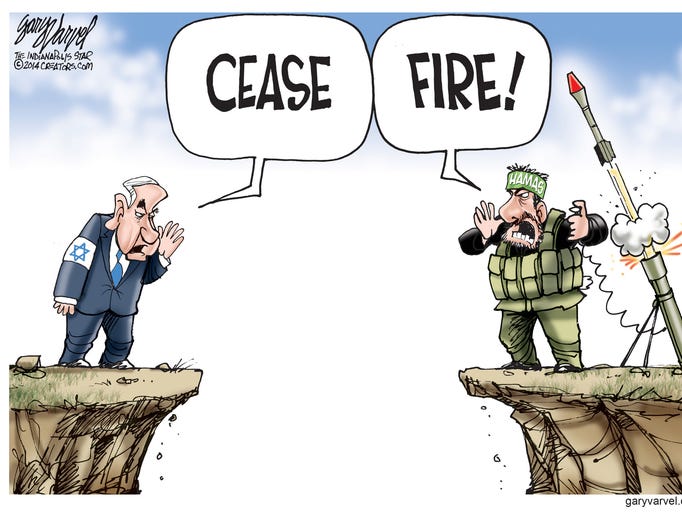
In the political cartoon above, the Israeli – Palestinian conflict is
clearly the topic of discussion. The obvious is that there is a political figure
of Israel, and a leader of the Hamas terrorist group. The man from Israel is
calling for a cease, yet the Hamas figure shouts fire. Interestingly, when you
put the two quotes together, you get “cease fire” which is what the main goal
is, however separate, there is a sense of bias established by the artist. It is
clearly an anti-Hamas piece since it portrays Israel as the poor man asking
them to cease, unarmed as well. This establishes the first rhetorical device,
which is pathos. It seems to turn all the blame on Hamas, while Israel can’t do
anything but continue to ask for peace. It gives the reader a sense of sympathy
for the helpless Israelis. Another rhetorical device that the artist uses is juxtaposition.
How you might ask? Well by using the two speech bubbles, he is comparing how
the Israelis are looking for peace, and the Hamas are looking for war. By
comparing these two, the audience can get a feel for who are the good guys, and
who are the bad guys through the bias shown in the cartoon. The author, Gary Varvel, is a political cartoonist
for the Indianapolis Star. Gary Varvel has been the editorial cartoonist for
The Star since 1994. The man clearly has plenty of experience with
political cartoons, thus establishing himself as a credible source. Through his
use of strong juxtaposition and his sympathetic appeal to pathos, Varvel
effectively communicates his purpose, which is that we need to support Israel
and defend the ones fighting for peace.
Sunday, October 4, 2015
TOW #4 - The Catcher Was a Spy (IRB)
The book The Catcher Was a Spy, is a story about a boy named Moe Berg. His parents came over from Ireland back in the 19th century, where they established a new life in Newark, NJ. Throughout the first half of the book, author Nicholas Dawidoff takes us on a journey throughout Moe's adolescents, all the way to the beginning of his baseball career. His message to the audience is that Moe Berg was not your typical stud baseball player who would chew tobacco, and smoke cigars at the time. He was one of the brightest men the game had ever seen, and could be respected just for his intelligence, let alone his baseball skills. Now Dawidoff isn't just some no name writer, who decided that the life of Moe Berg was a good idea to try and make some money; he was a legit author, who has won many awards for his work, including a Pulitzer Prize for his memoir The Fly Swatter. Dawidoff goes on to deliver his purpose through a plethora of rhetorical devices. Two of the main devices in the first half of the book are positive diction to describe the brilliance of Moe Berg, and the next one is establishing ethos for Moe Berg. To start off the biography, Dawidoff immidiately uses postive diction when he displays the nickname "Professor Berg". He then follows it up when he describes a conversation that one of his friends had with Berg; "Schacht is awed by the Berg presence" (Location 141)*. Later, Dawidoff continues with establishing the idea that Berg is a brilliant man by creating credibility for Moe. He stated, “Berg
exits carrying a bale of newspapers under his arm, foreign and domestic… he
greets him in Japanese," (Location 184)*. This quote emphasizes that Berg speaks fluently in more than one language, and that he is also an avid reader. These are two signs that immediately point to someone being knowledgeable and intelligent. Through the use of devices such as positive diction, and creating ethos for the main character, Moe Berg, Dawidoff effectively illustrates his purpose, which is that Moe was more than just a star baseball player from New Jersey.
*Reading on a Kindle, so not sure about page number, just location

*Reading on a Kindle, so not sure about page number, just location
Sunday, September 27, 2015
TOW #3 - War Child Advertisement
 |
The audience of the message then is clear. Not only is it directed towards the kids who are struggling in the areas of war, but its mostly to the people of third world countries, like the U.S. We have to embed in our children's minds that war is nothing even close to a game. It also promotes third world countries into donating towards the charity, to help the kids without proper structure, and who are at risk of becoming child soldiers. This message is delivered through the use of metaphors, pathos, and irony. The metaphor is clear, that war is a game. The purpose of the image is to then shut down that metaphor, and to convince people to help fight against the idea being that war is a game. The pathos is created by us being so urged to support the cause, just thinking of the child soldiers without education, parents, or a normal life. Lastly, the irony being that the balloon as a grenade, at first glance, seems to support the idea that war is a game, but then the texts contrasts that thought. Trough the use of these rhetorical devices, the War Child charity created a successful and effectively ad to draw people into donating to help the cause of child soldiers around the world.
Sunday, September 20, 2015
TOW #2 - Rethink U.S. arms sales to Bahrain
Recent legislation has been passed by the US
State Department that allows for the resume of arm sales to Bahrain. Conflict
arises with this decision because many people believe that the US should not
aid a country that purposefully represses peaceful protesters. In Bahrain, the
ruling regime has been cracking down on anyone who stands in the way of their
power, such as human rights activists, and opposing leaders. The reason the
State Department went through with this legislation is because the leaders have
said that they have fully implemented the recommendations of the Bahrain
Independent Commission of Inquiry, but in reality, have only established 5 out
of the 26. In the last paragraph, the author, Ron Wyden, states that he
strongly disagrees, and that, “The United States should only restart these arms
sales in response to real reform, not continued repression,” (Wyden para.
12). Wyden is definitely considered a
credible source based on the fact that he has significant experience in the
field of foreign policy, and that he has been in the House of Representatives
for 15 years. He has been in the senate for almost 20 years. The audience of
his op-ed is most likely adults aged 21-35. These are the people that are most
involved in the news, and the one with very strong political views. Wyden’s
purpose is clear; to argue that the passing of the bill to resume arm exchange
with Bahrain only shows that we are supporting repression, and not reform. He
delivers this message with rhetorical devices such as allusions. In the middle
of the editorial, he alludes to the prior events that have happened in the
Middle East, where peaceful protests lead to violence and chaos, started by the
regime trying to repress their activists. For this reason, I believe Wyden to
be successful in conveying his message of the fact that we must not support
those trying to repress freedom.

Tuesday, September 15, 2015
TOW #1 - Pope Francis and Donald Trump: Two Kinds of Power
Over the years, we have seen many leaders who have had different approaches to how they run their organization, or their country. There have been leaders of democracies, theocracies, and monarchies, all with different characteristics that separate them from one another. In this article, the leadership qualities of Pope Francis and Donald Trump are under the examination of Brian Frawley. Frawley is a former Catholic priest, and is now a principal of Hay Group in Boston. His practice focuses on leadership development and executive assessment, which combined makes him a pretty reliable source when it comes to an opinionated piece. The two types of leadership he discusses are "personal power" and "social power". Personal power "gathers energy and excitement from winning, from standing over and above others as conqueror and victor," (Frawley para. 3). He later goes on to explain how this type of power shows a strong desire for control. On the other hand, social power is aimed towards elevating others, expressing their full potential. The audience of this op-ed is most likely adults aged 21-35, because they are the most involved in these kinds of politics. Also, they are the ones responsible for whether or not Trump will be elected president. With that being said, clearly the rhetoric being used by the author was juxtaposition. He is essentially comparing the difference between two types of power, and then goes on to explain how they are successful, and likewise, unsuccessful. If we pay close attention, we can see that the author favors social power over personal power, and by using juxtaposition, he gets his purpose across to the reader in a well organized fashion. In my opinion, the purpose of the text is simple: to exploit one type of power (personal), and to support the benefits of another (social). When Frawley discusses the idea of social power, he uses a much more inspiring tone, compared to the basic monotone of personal power. He states, "It draws on inspiring language and symbolic actions to help people find their own power, both individually and collectively..." (Frawley para. 7). So when it comes to whether or not the author wrote a successful op-ed, I side with yes due to the strong examples he uses, along with the rhetorical devices.


Monday, September 14, 2015
IRB Intro Post
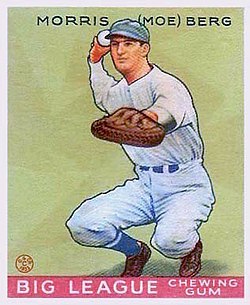
The title of the book that I have chosen is The Catcher Was a Spy, written by Nicholas Dawidoff. The book singles out a catcher in Major League Baseball, whose name is Moe Berg. It is essentially a biography about how Berg spent 16 years in the MLB, and played for five different teams. However at age 39, Berg put to use his foreign language skills, and enrolled in the military as the United States entered World War II. The book later goes into in depth details about some of Moe's missions as a US spy, specifically about his investigations on Germany's work on nuclear energy and atomic weapons. The author provides the reader with a careful and sympathetic story about the struggles and successes of the only Major League Player to have his baseball card on display at the CIA headquarters in New York. I chose to read this book because it combines two things that I thoroughly enjoy: baseball and war efforts. My goal from reading this biography is to learn more about what the life was like first hand in WWII, and also to learn about the story of a man who had it all, and chose to help defend his country, instead of watching from the comfort of his home.
Sunday, August 30, 2015
The Figure a Poem Makes
Written by Robert Frost, The Figure a Poem Makes is an essay about the craftsmanship of the perfect poem. Frost is a highly regarded poet who blends a unique still with a delicate tone, making him such a credible source for such an essay. There are three main topics of his essay: a poem should consist of a sense of wildness, a poem should be fresh and keep its freshness, and the Poem should begin in delight and end in wisdom. Through rhetorical questions and similes, Frost delivers his purpose, which is that a poet should be original and should have a sense of initiative. They can take the poem in any way that they want, but should remain original throughout the whole process. The author argues that a poem of a "precious quality" should carry away the reader by beginning with delight, then ending in wisdom. That is the key to creating a poem with the desired freshness of a great poet. One example of how he delivers this message is through a rhetorical question, as I mentioned before. Frost asks, "Why can't we have any one quality of poetry we choose by itself?" (Pg. 176). By asking rhetorical questions like this, he requires the reader, which is most likely a poet, to think by himself and come up with an original answer. This creates the thinking style of a great poet. He then also used a simile to accomplish the same purpose when he stated, "Read it a hundred times: it will forever keeps its freshness as a metal keeps its fragrance" (pg. 178). Frost uses this to give a good reader an idea of what a fresh poem should resemble, and once the poet has this in mind, he can then apply it to his work. For this reason, I believe Frost created a well crafted essay that successfully displays his purpose.

Caption: No matter how long grass is around, and as long and it is well tended to, it will remain fresh no matter how many time you look at it. This is one of the main point Frost tries to make; that a poem should remain fresh, even after you read it 100 times.
Title: Morning Dew on Fresh Grass
Source: Wallcraft.com

Caption: No matter how long grass is around, and as long and it is well tended to, it will remain fresh no matter how many time you look at it. This is one of the main point Frost tries to make; that a poem should remain fresh, even after you read it 100 times.
Title: Morning Dew on Fresh Grass
Source: Wallcraft.com
The Lives of a Cell
In The Lives of a Cell, Lewis Thomas gives a fun and interesting spin on the world of biology. Through analogies and metaphors, the author connects man to nature in a very though provoking way. He begins by stating that we have been trying to detach from nature in recent years. He then continues to provide several examples of certain cells, revealing that without them, we are nothing. Take the mitochondria for example: without them, we wouldn't be able to eat, sleep, move, or even think! Considering the scientific content, as readers, we might not buy into what the author is revealing because, well, he is an author, and biology is probably not his forte. However, he was a graduate of Princeton University, and also Harvard Medical School. That certainly gives him credibility relating to the content. In the year of 1971, which was when the essay was written, biology wasn't much of a norm in society. However, through his findings, research, and essays, he opened up a whole new world, and stimulated others to enter the field. This further displays the purpose of his essay, which was to inform the uneducated public about the wonders of cells and how the function in the human body. He then goes on to connect humans to nature, arguing that Earth is most like a single cell. To get this point across, Lewis Thomas uses metaphor as a rhetorical device. During the last paragraph, he starts of by stating, "I have been trying to think of the earth as a kind of organism," (pg. 360). Then he later makes his argument by saying that the earth is most like a single cell. This helps to deliver his purpose and his argument because through his research, we as readers are then able to connect that human interactions on Earth are similar to those, such as the mitochondria, in a single felled organism.

Caption: One of the overall messages in Thomas' works was that humans cannot separate themselves from nature because, like the earth, we are very complex consisting on of many working parts. He goes on to state that, ""Man is embedded in nature" (pg. 358).
Title: We Are The World
Source: Eric Yahnker

Caption: One of the overall messages in Thomas' works was that humans cannot separate themselves from nature because, like the earth, we are very complex consisting on of many working parts. He goes on to state that, ""Man is embedded in nature" (pg. 358).
Title: We Are The World
Source: Eric Yahnker
Bop - Langston Hughes
In the essay Bop by Langston Hughes, a type of music called "Bop" is discussed between a couple of friends during the time of strong racism and the Jim Crow Laws. African Americans were viewed as second-class citizens, and were treated quite poorly in the U.S. The narrator displays a sense of ignorance to his friend Simple, when he expresses his opinion about the nonsensical and silly lyrics. To that, Simple describes the meaning behind the music, which is to resemble to noises of police officers beating African Americans' heads. Thus exploiting Hughes' plain ignorance. Hughes' purpose of the lesson on "Bop" is to display how we treat different races, and to reveal the societal flaw of the unfair prejudice we place on African Americans. Langston Hughes was a man who at the time, dealt with the racism and unfair treatment, making him a very credible source to deliver the message he introduces in his essay. Being a civil rights activist, Hughes, and the whole African American community, is striving towards desegregation and equal rights, providing the argument in his essay. In order to deliver the message, he uses juxtaposition as a powerful rhetorical device. He places the treatment of blacks and whites during the time; comparing how they differ. He first describes how the police poorly treat the blacks, then explains treatment of white people. "White folks do not get their heads beat just for being white" (pg. 191). This helps by allowing the audience, most likely the majority of the white population and police officers, to compare and understand the struggle black people had to deal with in overcoming the prejudice we placed upon them. In my opinion, this allows Hughes to successfully convey his purpose and his message to the reader. By using strong rhetorical devices, and giving vivid visualizations, Hughes creates a well organized and meaningful essay.


Caption: Even though we have abolished the Jim Crow Laws, and limited racism over the past 50 years, it still continues to exist in today's society. Although a mojo rite of the violence is claimed to be in self defense, racism seems evident meaning that the work of Hughes and other civil rights activist has simply gone down the drain.
Title: Stop Police Brutality
Source: Revolutionary Web Design.com
Subscribe to:
Posts (Atom)